European Roulette Guide: Rules, Odds, and Strategy
Master the single-zero wheel
European roulette is the most widely played roulette variant in the world and the foundation for virtually all roulette strategy. With 37 pockets, a single zero, and a 2.70% house edge, it offers significantly better odds than its American counterpart. This guide covers everything you need to know: how the wheel works, every bet type and its payout, the math behind the house edge, and which strategies perform best on the single-zero wheel.
What Is European Roulette?
European roulette is a casino table game played on a wheel with 37 numbered pockets: 1 through 36 plus a single green zero (0). Players place bets on where a small ball will land after the wheel is spun. The single zero is the casino's built-in advantage, giving the house a 2.70% edge on every bet.
Unlike American roulette, which adds a double zero (00) for 38 pockets and a 5.26% house edge, European roulette uses only one zero pocket. This single difference makes European roulette the preferred choice for serious players and the standard for strategy design.
The European Wheel
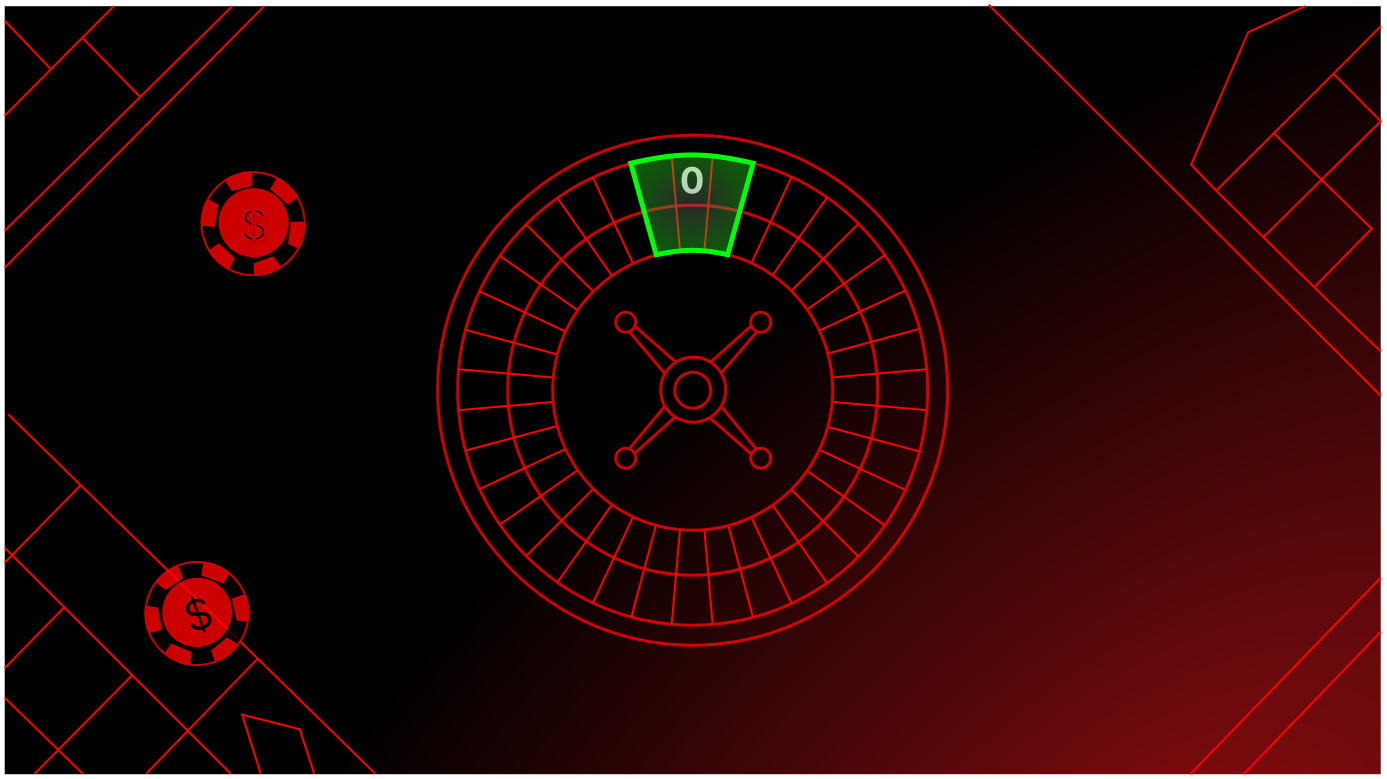
The European roulette wheel contains 37 pockets arranged in a specific sequence. Of the 36 numbered pockets, 18 are red and 18 are black. The zero pocket is green.
Number Sequence
The numbers on a European wheel are not arranged sequentially. Instead, they follow a carefully designed order that distributes red/black, high/low, and odd/even numbers as evenly as possible around the wheel. Reading clockwise from zero:
0, 32, 15, 19, 4, 21, 2, 25, 17, 34, 6, 27, 13, 36, 11, 30, 8, 23, 10, 5, 24, 16, 33, 1, 20, 14, 31, 9, 22, 18, 29, 7, 28, 12, 35, 3, 26.
European Wheel Layout (37 Pockets)
Section Bets (Call Bets)
Why the Layout Matters
The wheel layout is designed so that adjacent pockets alternate between red and black, and alternate between high (19-36) and low (1-18) as much as possible. This matters for section bets and neighbor bets, which are based on physical wheel position rather than the numbered grid on the table.
Three traditional section bets are based on the European wheel layout:
- Voisins du Zero (Neighbors of Zero): 17 numbers surrounding zero on the wheel
- Tiers du Cylindre (Third of the Wheel): 12 numbers on the opposite side from zero
- Orphelins (Orphans): The remaining 8 numbers not covered by Voisins or Tiers
Understanding the House Edge
The house edge in European roulette is 2.70% on every bet. This number is not arbitrary - it comes directly from the relationship between the number of pockets and the payout structure.
The Math
All roulette payouts are calculated as if there are 36 numbers on the wheel. A straight-up bet on a single number pays 35:1 (36 minus your 1 winning number = 35). But the wheel has 37 pockets, not 36. That extra pocket - the zero - is the source of the house edge.
For a straight-up bet: you win 1 out of 37 spins (2.70%) and get paid 35:1. The fair payout would be 36:1 for 37 pockets. The difference between the fair payout (36:1) and the actual payout (35:1) is the house margin.
Mathematically: (37 - 36) / 37 = 1/37 = 2.70%
This applies uniformly to every bet on the table. Whether you bet on a single number, a split, a dozen, or red/black, the house edge remains 2.70%.
What 2.70% Means in Practice
For every $100 you wager, you can expect to lose $2.70 on average over the long run. Over 1,000 bets of $10 each ($10,000 total wagered), your expected loss is $270. This is significantly better than American roulette, where the same wagering would cost you $526.
Bet Types and Payouts
European roulette offers two categories of bets: inside bets (placed on specific numbers or small groups on the numbered grid) and outside bets (placed on larger groups in the areas surrounding the grid).
Inside Bets
Inside bets cover individual numbers or small clusters of adjacent numbers on the table layout. They offer higher payouts but lower win probabilities.
Straight Up (35:1)
A bet on a single number. Place your chip directly on the number. Covers 1 out of 37 pockets for a 2.70% win probability.
Straight Up: $1 on 17
Covers 1 number. Win probability: 2.70% (1/37). Payout: 35:1 ($35 profit)
Split (17:1)
A bet on two adjacent numbers. Place your chip on the line between two numbers. Covers 2 out of 37 pockets for a 5.41% win probability.
Split: $1 on 17-18
Covers 2 numbers. Win probability: 5.41% (2/37). Payout: 17:1 ($17 profit)
Street (11:1)
A bet on three numbers in a horizontal row. Place your chip on the outer edge of the row. Covers 3 out of 37 pockets for an 8.11% win probability.
Street: $1 on 16-17-18
Covers 3 numbers. Win probability: 8.11% (3/37). Payout: 11:1 ($11 profit)
Corner (8:1)
A bet on four numbers that form a square on the layout. Place your chip at the intersection where all four numbers meet. Covers 4 out of 37 pockets for a 10.81% win probability.
Corner: $1 on 16-17-19-20
Covers 4 numbers. Win probability: 10.81% (4/37). Payout: 8:1 ($8 profit)
Double Street / Six Line (5:1)
A bet on six numbers spanning two adjacent rows. Place your chip on the outer corner shared by two rows. Covers 6 out of 37 pockets for a 16.22% win probability.
Double Street: $1 on 16-17-18-19-20-21
Covers 6 numbers. Win probability: 16.22% (6/37). Payout: 5:1 ($5 profit)
Outside Bets
Outside bets cover larger groups of numbers and offer lower payouts but higher win probabilities. These are the most popular bets for progression-based strategies.
Red / Black (1:1)
Bet on all 18 red or all 18 black numbers. Zero is neither red nor black. Win probability: 48.65% (18/37).
Even-Money: $1 on Red
Covers 18 numbers. Win probability: 48.65% (18/37). Payout: 1:1 ($1 profit)
Odd / Even (1:1)
Bet on all 18 odd or all 18 even numbers. Zero counts as neither odd nor even. Win probability: 48.65% (18/37).
High / Low (1:1)
Bet on Low (1-18) or High (19-36). Zero is not included in either range. Win probability: 48.65% (18/37).
Dozens (2:1)
Bet on the first dozen (1-12), second dozen (13-24), or third dozen (25-36). Each dozen covers 12 numbers. Win probability: 32.43% (12/37).
Dozen: $1 on 1st Dozen (1-12)
Covers 12 numbers. Win probability: 32.43% (12/37). Payout: 2:1 ($2 profit)
Columns (2:1)
Bet on one of three vertical columns of 12 numbers each. Column 1 contains 1, 4, 7, 10, 13, 16, 19, 22, 25, 28, 31, 34. Win probability: 32.43% (12/37).
Column: $1 on Column 1
Covers 12 numbers. Win probability: 32.43% (12/37). Payout: 2:1 ($2 profit)
Complete Payout Table
The following table lists every bet type in European roulette with its coverage, payout, and exact win probability.
| Bet Type | Numbers Covered | Payout | Win Probability | House Edge |
|---|---|---|---|---|
| Straight Up | 1 | 35:1 | 2.70% | 2.70% |
| Split | 2 | 17:1 | 5.41% | 2.70% |
| Street | 3 | 11:1 | 8.11% | 2.70% |
| Corner | 4 | 8:1 | 10.81% | 2.70% |
| Double Street | 6 | 5:1 | 16.22% | 2.70% |
| Dozen | 12 | 2:1 | 32.43% | 2.70% |
| Column | 12 | 2:1 | 32.43% | 2.70% |
| Red / Black | 18 | 1:1 | 48.65% | 2.70% |
| Odd / Even | 18 | 1:1 | 48.65% | 2.70% |
| High / Low | 18 | 1:1 | 48.65% | 2.70% |
Best Strategies for European Roulette
European roulette's 2.70% house edge makes it the standard wheel for all progression-based strategies. The choice of strategy depends on your risk tolerance, bankroll size, and preferred bet types.
Even-Money Bet Progressions
These progressions work on Red/Black, Odd/Even, or High/Low bets with their 48.65% win rate:
- Martingale - Double after each loss. High risk, requires large bankroll. Recovers all losses with a single win.
- D'Alembert - Increase by one unit after a loss, decrease by one after a win. Lower risk than Martingale, slower recovery.
- Fibonacci - Follow the Fibonacci sequence after losses. Moderate risk, mathematically elegant recovery path.
- Paroli - Double after each win (reverse Martingale). Low risk, capitalizes on winning streaks with built-in profit protection.
- Oscar's Grind - Increase by one unit after a win, hold after a loss. Conservative approach targeting one unit of profit per cycle.
Dozen and Column Strategies
Dozens and columns cover 12 numbers each (32.43% win rate) with a 2:1 payout. Combining two dozens or two columns covers 24 numbers (64.86% win rate), which is the foundation of multi-strategy sessions. These higher-coverage approaches reduce variance while maintaining meaningful profit potential.
Inside Bet Strategies
Inside bets (straights, splits, corners, streets) offer higher payouts but lower win probabilities. They are best paired with the Labouchere progression, which allows flexible target-based recovery across multiple spins.
Combined Inside Bet Example
Straight on 17 + Corner on 16-17-19-20 + Split on 14-15. Multiple inside bets create overlapping coverage.
European vs Other Variants
European roulette sits in the middle of the three main variants in terms of player advantage:
- French roulette uses the same 37-pocket wheel but adds the La Partage rule, which returns half your even-money bet when zero hits. This drops the house edge to 1.35% on even-money bets - the best odds in roulette.
- American roulette adds a double zero (00) pocket for 38 total, nearly doubling the house edge to 5.26%. Payouts remain identical, so every bet is strictly worse.
For a detailed breakdown of all three variants, see the European vs American vs French Roulette comparison.
Try European Roulette
Use the interactive demo below to practice placing bets on a European roulette board. Experiment with different bet types and see the results in real time.
Try it yourself - place bets on the European roulette board and spin the wheel.
Click a number on the board to start simulation
Place at least one bet to simulate outcomes
Frequently Asked Questions
What is the house edge in European roulette?
The house edge in European roulette is 2.70% on every bet. This comes from the single zero pocket: payouts are calculated as if there are 36 numbers, but the wheel has 37 pockets. The formula is (37 - 36) / 37 = 1/37 = 2.70%.
How many pockets does a European roulette wheel have?
A European roulette wheel has 37 pockets: numbers 1 through 36 alternating between red and black, plus a single green zero (0). This is one fewer pocket than the American wheel, which adds a double zero (00) for 38 total.
What is the best bet in European roulette?
All bets carry the same 2.70% house edge, so no single bet is mathematically superior. Even-money bets (Red/Black, Odd/Even, High/Low) offer the highest win probability at 48.65% and lowest variance, making them the most popular choice for progression-based strategies.
What is the difference between European and American roulette?
European roulette has one zero (37 pockets, 2.70% house edge). American roulette has both a zero and a double zero (38 pockets, 5.26% house edge). Payouts are identical, so European roulette gives players significantly better odds. See the full comparison guide for details.
Can you use betting strategies on European roulette?
Yes. European roulette's 2.70% house edge makes it the standard wheel for strategy play. Progressions like Martingale, D'Alembert, Fibonacci, and Paroli are all designed around European roulette probabilities.
Related Guides
- European vs American vs French Roulette - Complete variant comparison with odds and strategy impact
- How Table Layout Affects Strategy - Bet zones, number positions, and neighbor relationships
- Martingale Progression Guide - Classic doubling system for even-money bets
- D'Alembert Progression Guide - Conservative equilibrium-based system
- Fibonacci Progression Guide - Mathematical sequence-based recovery
- Multi-Strategy Sessions - Run 4 strategies simultaneously for 86.5% table coverage